Transit Atlas

The long read

Notes, readings and sources

Everything behind the ride: what the official map shows, the districts, the stolen weather walls, Los Angeles, what critics wrote and where every fact comes from.

The two films' politics at a glance

Each theme, where it happens in the films, and who has written about it. Items marked "ours" are this project's readings.

  • Diversity and inclusion. Judy becomes the city's first rabbit officer and is put on parking duty by a chief who doubts her (Zootopia, 2016).
  • Prejudice and racism. Predators are feared as a group after Judy blames their biology. Matt Zoller Seitz (RogerEbert.com, 2016) argued the metaphor treats stereotypes as "to some extent true."
  • Policing. Gene Demby (NPR Code Switch, 2016) found the film sharp on profiling, but in the end Judy "doubles down on the status quo."
  • A drug aimed at one group. Night Howler flowers are made into a serum and shot at predators, in a plot by the assistant mayor to win power through fear. Critics read it that way too: Eric Eisenberg (CinemaBlend, 2022) pointed to the "CIA having a hand in the distribution of crack cocaine in the inner cities," and Jennifer Fleeger (Public Books, 2016) to a "drug lab." Ours: we set it next to the crack era in Los Angeles: the 1986 law that punished 5 grams of crack like 500 grams of powder cocaine, and the "Dark Alliance" series (1996) that tied LA's crack trade to CIA-backed Contra rebels, whose claims are still disputed.
  • Separate districts, one city. Every species gets its own climate, linked by one subway. Ours: ethnic enclaves and ethnoburbs that keep a culture and still share a city.
  • Colonialism and a stolen invention. A snake invents the weather walls; a lynx family steals the credit (Zootopia 2, 2025). Nadira Goffe (Slate, 2025) called it "settler colonialism."
  • Displacement and a buried district. Reptile Ravine is buried under snow to build Tundratown, and Tundratown plans to swallow Marsh Market next. Karlie Rogers (Exclaim!, 2025): "forced displacement, cultural erasure and scapegoating."
  • Scapegoating. One death is blamed on one snake, and all reptiles are expelled. On NPR's Pop Culture Happy Hour (2025), Candice Lim asked "is the snake Asian?" Ours: Chinese railroad and levee workers, the 1882 Chinese Exclusion Act, and Asian Americans blamed as a group.

What the filmmakers said

In their own words. None of them uses the words colonialism, immigration or gentrification; those readings belong to critics and to this project.

  • “wouldn't this be a great way to talk about bias?”

    Byron Howard, co-director, TheWrap, 7 December 2016

  • “With talking animals, you can somehow say something about human bias and prejudice and racism.”

    Phil Johnston, co-writer, TheWrap, 7 December 2016

  • “the natural percentage of animals in the wild is 90 percent prey and 10 percent predators”

    Rich Moore, co-director, TheWrap, 7 December 2016

  • “that's an automatic majority minority”

    Byron Howard, /Film, 3 March 2016

  • “They had to wear these collars that would give them a shock if they had old instinctual urges”

    Rich Moore, on the first version of the story, /Film, 3 March 2016

  • “a big vibrant melting pot that you can find good and you can find bad”

    Rich Moore, on the rewrite, /Film, 3 March 2016

  • “Modeled in part after Disneyland's hub-and-spoke design, Savanna Central is Zootopia's central hub.”

    Disney's district text, DisneyGeek, 1 December 2015

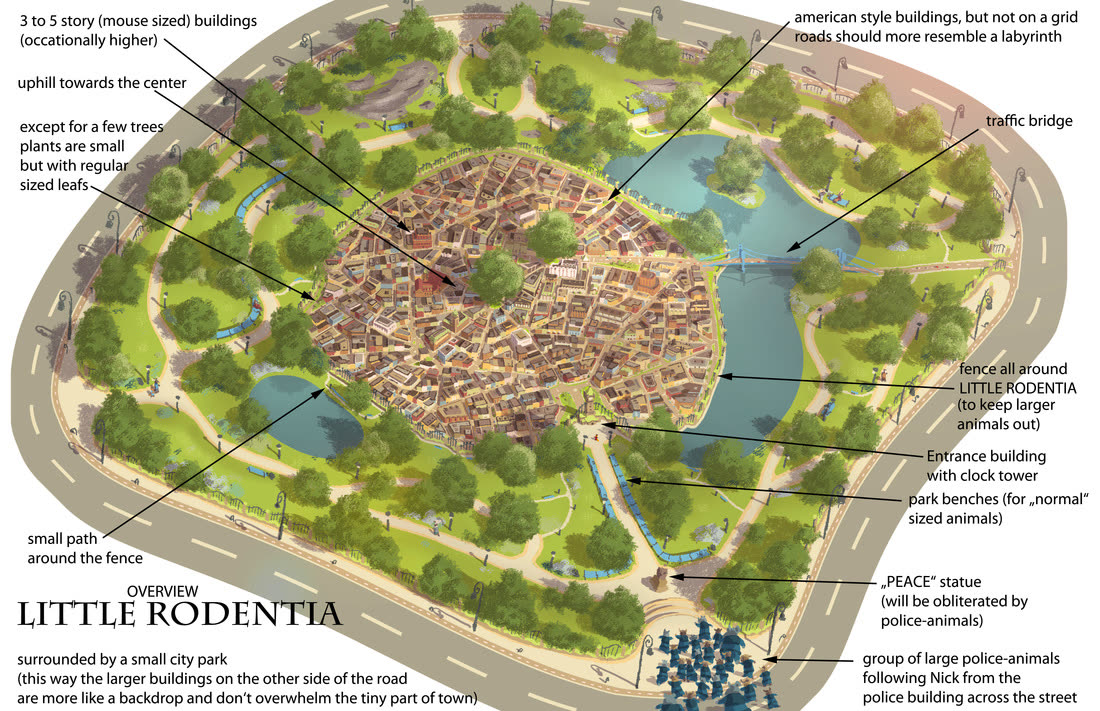
  • “It's surrounded by a big fence so that big animals can't walk through it.”

    Matthias Lechner, art director, on Little Rodentia, DisneyGeek, 1 December 2015

  • “We had talked in the first film about how there are probably reptiles that exist in this world, but we're not showing them”

    Byron Howard, on Zootopia 2, TheWrap, 29 September 2025

  • “the only real way to tell that story is historically.”

    Jared Bush, co-director, TheWrap, 29 September 2025

  • “It's always been a story about exploring and talking about why reptiles weren't in Zootopia”

    Yvett Merino, producer, Screen Rant, 29 September 2025

  • “not judge someone with a preconceived background and stereotypes and all these labels”

    Ke Huy Quan, voice of Gary, Collider, 29 November 2025

Scholarship

Academic writing on the first film, found through Crossref. Where we could not read the full text, we list it without describing its argument.

  • Xiao Huang, “City of All Sizes: Zootopia as a Blueprint for Inclusive Design and Accessibility.” Journal of Planning Education and Research, 2026. doi:10.1177/0739456x261474863. Reads the city as a planning case: urban form, mobility, services and climate built for every size.
  • Kevin Chew, “On war and cuteness: the utopian politics of Disney's Zootopia.” Screen 60(4): 567-586, 2019. doi:10.1093/screen/hjz043.
  • Clio Andris and Juan Ruescas, “Zootopia (review).” Transfers: Interdisciplinary Journal of Mobility Studies 7(1): 141-144, 2017. doi:10.3167/trans.2017.070112. A review in a mobility-studies journal.
  • Ana Virginia López Fuentes, “Cosmopolitan and border experiences in the global city of Zootopia.” Revista de Estudios Norteamericanos 25: 163-184, 2021. doi:10.12795/ren.2021.i25.08. A city of neighbourhoods with contrasting habitats, "separated by physical walls."
  • Sarah Nilsen, “Living in Zootopia: Tracking the Neoliberal Subject in a Colorblind World.” in The Myth of Colorblindness (Palgrave Macmillan), 61-88, 2019. doi:10.1007/978-3-030-17447-7_4.
  • Gregory Beaudine, Oyemolade Osibodu and Aliya Beavers, “Disney's Metaphorical Exploration of Racism and Stereotypes: A Review of Zootopia.” Comparative Education Review 61(1): 227-234, 2017. doi:10.1086/690061.
  • Eve Benhamou, “Animal Action Buddies: Disney's Anthropomorphic Reimaginings in Zootopia.” in Contemporary Disney Animation (Edinburgh University Press), 180-205, 2022. doi:10.3366/edinburgh/9781474476126.003.0008.
  • Jill Bindewald, “Just a Stupid Carrot Farm, Dumb Bunny.” in Disciplinary Literacy Connections to Popular Culture in K-12 Settings (IGI Global), 69-92, 2021. doi:10.4018/978-1-7998-4721-2.ch004. Rural life and leaving the farm for the city.
  • Jennifer Fleeger, “Policing the Borders of Zootopia.” Public Books, 16 March 2016. publicbooks.org. "The city itself is segregated, but that division is seen as ‘natural.’"

What the subway map teaches

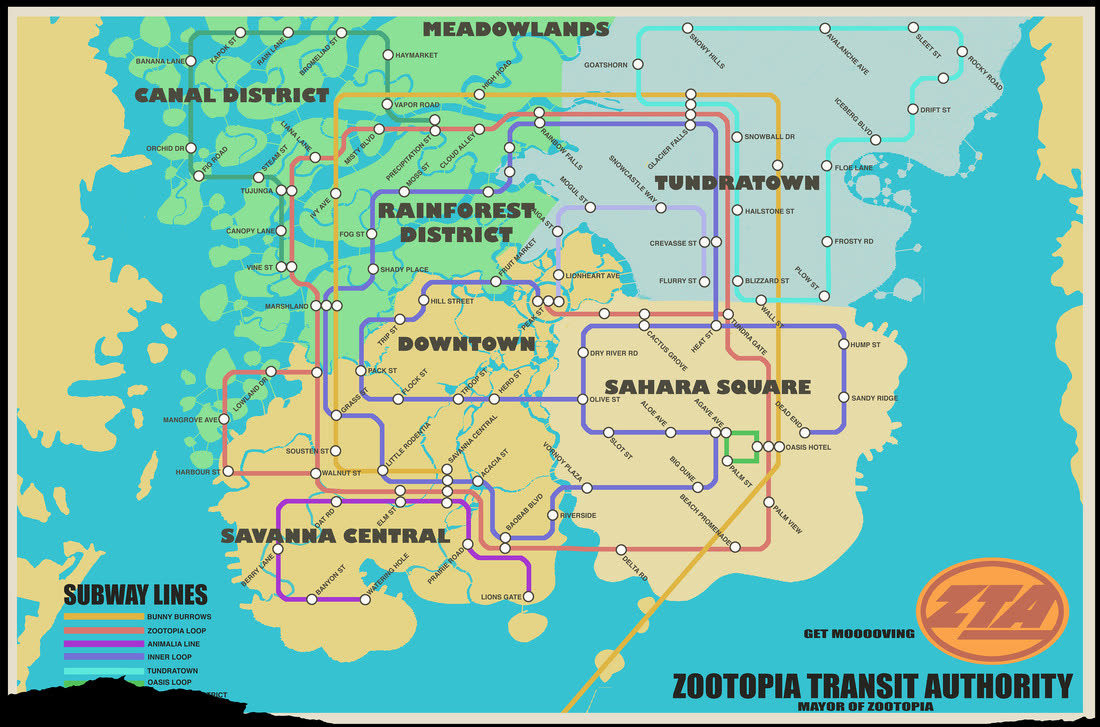
Read the official map the way a planner would. Each point is something you can check on the map itself.

  1. Every line passes the middle

    The lines cross in Downtown and Savanna Central. Each district is its own place, but nobody is more than a change of trains from the centre of the city.

  2. Districts get their own loops

    The Tundratown line stays in the snow, the Oasis Loop circles a few blocks of Sahara Square, and a green line winds through the canals. Local trips for local life, on top of the lines that tie the city together.

  3. The countryside is on the map

    The gold Bunny Burrows line runs off the bottom of the sheet toward farm country 200 miles away. Judy comes to the city by train, not by car.

  4. The smallest residents get a stop

    Little Rodentia has its own station. The map plans for animals a few inches tall as well as for elephants.

  5. The mayor signs it

    "Mayor of Zootopia" is printed under the transit authority's name. Getting around is a public service, and someone in City Hall answers for it.

  6. Who isn't on it

    No stop serves the reptiles. Zootopia 2 tells us why: they were pushed out a century ago and their district lies buried under Tundratown's snow. A transit map shows who a city plans for, and who it has stopped counting.

The official maps

Concept art by Matthias Lechner, the art director for environments on Zootopia (2016), from his own portfolio. He posted the subway map with the note: "If you ever visit Zootopia this subway map might come in handy..."

The Zootopia Transit Authority subway map: coloured lines over a pale map of the districts, from the Canal District and Tundratown in the north to Savanna Central and Sahara Square in the south.
Official Zootopia Transit Authority subway map. Seven lines, from the gold Bunny Burrows line that leaves the sheet toward Judy's hometown to the tiny Oasis Loop. Concept art by Matthias Lechner, art director. © Disney. Source: matthiaslechner.com.
An annotated overview of Little Rodentia: a tiny town of mouse-sized buildings inside a fenced park, with notes in the margins.
Official Little Rodentia, overview. The notes ask for a "fence all around Little Rodentia (to keep larger animals out)". Concept art by Matthias Lechner. © Disney.
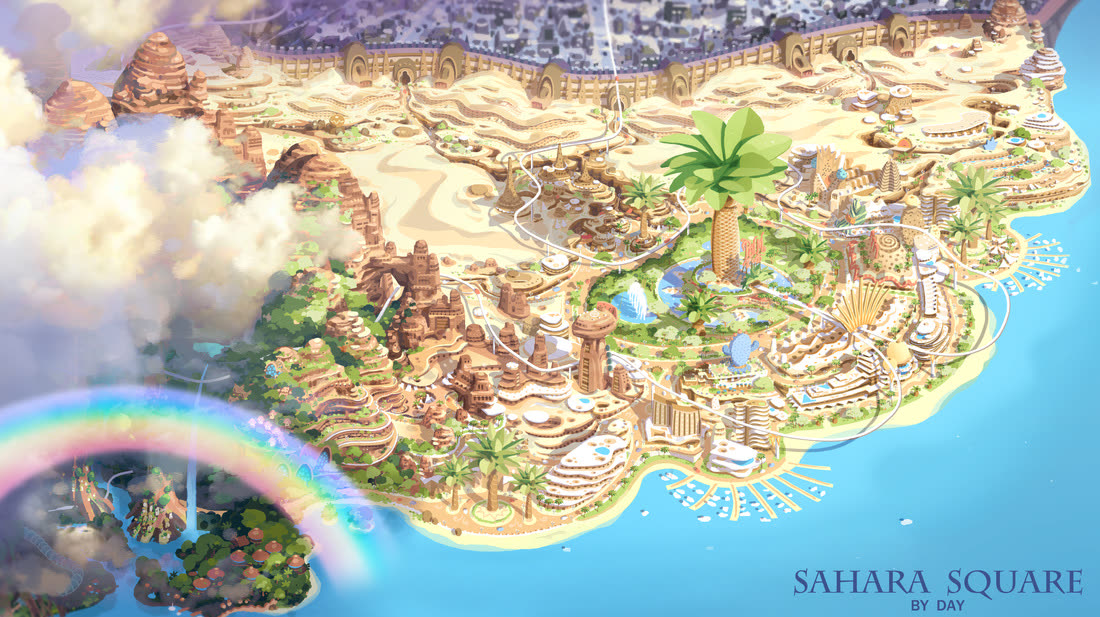
Sahara Square from the air by day: sand-coloured terraces and a giant palm tree hotel on a peninsula, with snowy Tundratown along the top edge.
Official Sahara Square by day. Look at the top edge: snow begins right where the desert ends. Concept art by Matthias Lechner. © Disney.
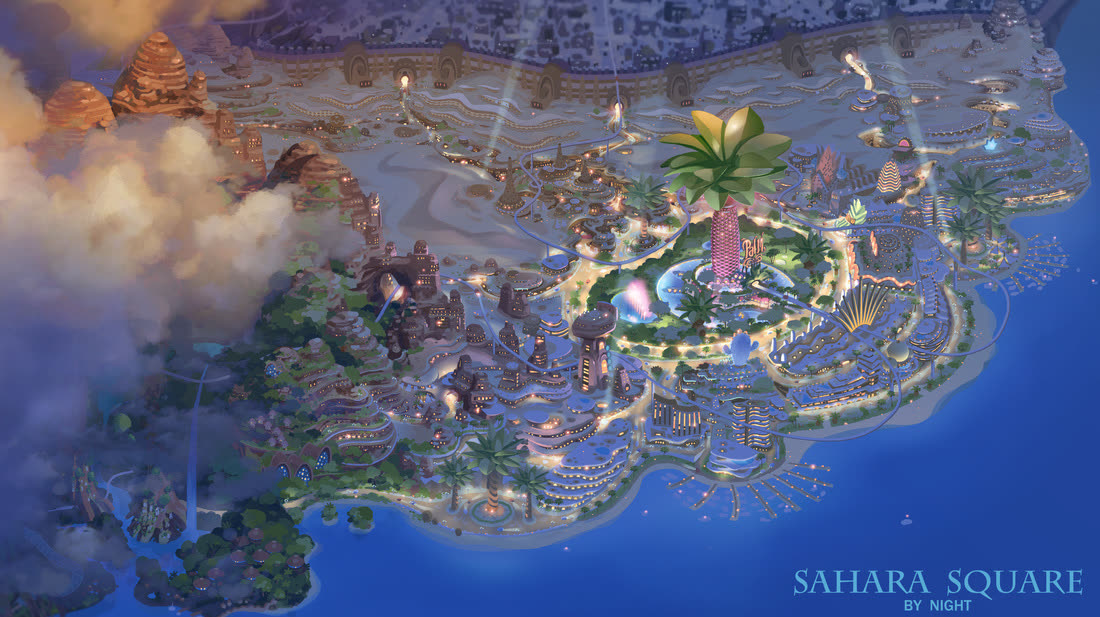
Sahara Square from the air at night, lit up around the palm tree hotel.
Official Sahara Square by night, when its nocturnal residents are out. Concept art by Matthias Lechner. © Disney.
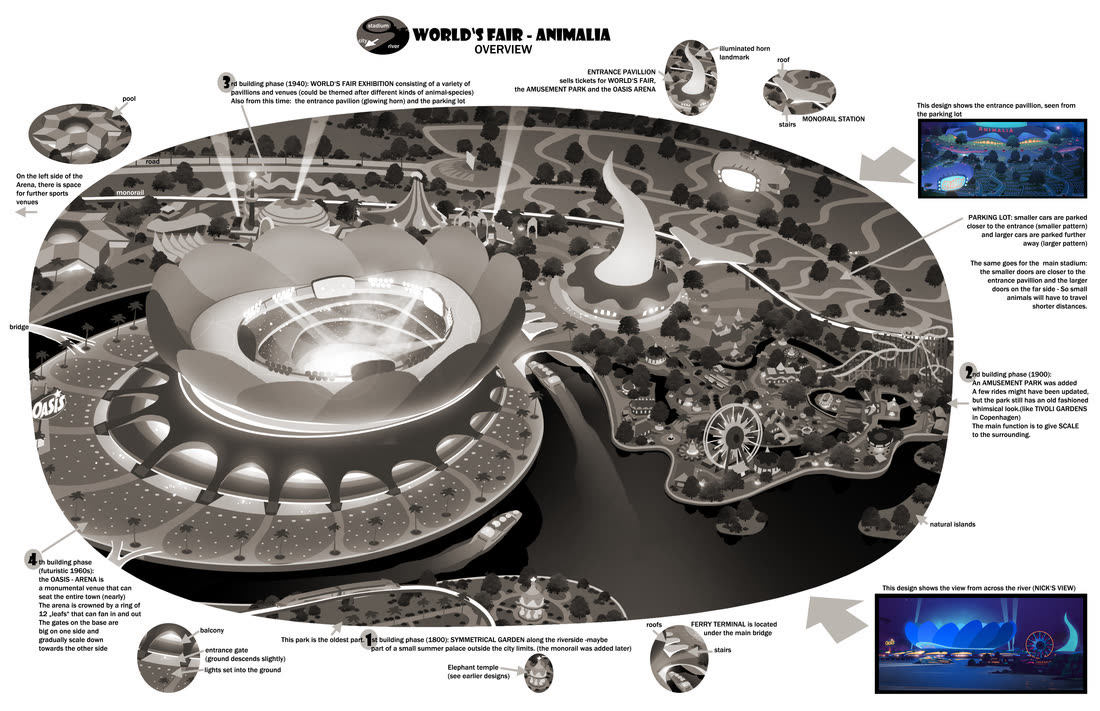
A grey annotated overview of a world's fair site called Animalia, with an arena shaped like a crown of leaves, a fairground and a monorail.
Official "World's Fair, Animalia": a site planned in four building phases, from an 1800 garden to a 1960s arena. The purple subway line carries the same name. Concept art by Matthias Lechner. © Disney.

What about the colourful city map online?

A flat-colour map of the whole city circulates online, with names like Canyonlands, Gnu York and Otterdam. Several of its names match fans' readings of a wall map seen briefly in the ZPD briefing room in the first film, but the drawing itself is a fan redraw and we could not find who made it, so it is not shown here.

Separate climates, one city

Each district is built for the bodies and habits of the animals who live there. All of them share a downtown, a police force, a mayor and a subway.

This project's reading

Zootopia does not ask anyone to fit one climate. A polar bear does not have to live in the desert to be a citizen. Read as a city of people, the districts look like ethnic enclaves and ethnoburbs: Koreatown, Little Saigon, the Chinese suburbs of the San Gabriel Valley. People keep their language, food, shops and churches close by, and still work, vote and ride the train with everyone else.

The subway map makes the case better than any speech. Every line runs through Downtown or Savanna Central. You can live in your own district and still be one stop from everyone else.

The film also shows the cost. Little Rodentia has a fence, and the fence works both ways: it keeps the smallest animals from being stepped on, and it keeps everyone else out. And the districts only exist because the city runs huge machines to make them. Who built those machines is the question of the sequel.
Tundratown

ClimateArctic, kept cold by snow blowers and the cold side of the weather wall

WhoArctic animals; in Zootopia 2, the Lynxley family of lynxes in Lynxley Manor

Built for themBuilt mainly of ice and snow. Floating blocks of ice stand in for moving sidewalks, and cars run on skis.

Sahara Square

ClimateHot desert, warmed by the hot side of the weather wall it shares with Tundratown

WhoNocturnal desert animals

Built for themSand dunes and buildings shaped like sand dunes. A night district of casinos, a giant palm tree hotel and the oasis around it.

Rainforest District

ClimateHot, wet and misty

WhoRainforest animals

Built for themMore than half a million giant trees, with walkways, bridges and gondolas strung between them.

Savanna Central

ClimateWarm and dry, with no climate machinery of its own

WhoAnimals from every district

Built for themThe central hub: the police headquarters (ZPD), City Hall and Central Station, where Judy Hopps steps off the train. Animals from each district converge here.

Little Rodentia

A town for the smallest mammals inside Savanna Central: mouse-sized houses, shops and streets. The art director's plan marks a "fence all around Little Rodentia (to keep larger animals out)" and a small park around it so the bigger buildings across the road "don't overwhelm the tiny part of town".

Zootopia 2: who built the walls?

The city's 100th birthday is a party for the family that says it invented the weather walls. A snake turns up with proof that they didn't.

  1. About 100 years ago

    Agnes De'Snake, a snake, invents the weather walls that make the climate districts possible.

  2. Then

    The investor Ebenezer Lynxley steals her designs. His tortoise maid tries to stop him burning Agnes's patent and dies; he frames Agnes for her death.

  3. After

    One death blamed on one snake turns the city against all reptiles. They are driven out, and their district, Reptile Ravine, is buried under snow to build Tundratown.

  4. The Zootennial

    A century later the Lynxleys host the gala for the walls' 100th anniversary. Gary De'Snake, Agnes's great-grandson, breaks in to take the old journal that proves what happened.

  5. Now

    The reptiles still in the city hide in Marsh Market, and Tundratown plans to expand into it.

  6. The end

    Agnes is credited, the expansion is called off and Reptile Ravine is thawed so reptiles can come home.

Plot: Wikipedia's Zootopia 2 summary and the film's production notes.

This project's reading

The weather walls are the reason Zootopia works, and the animal who made them is missing from the city's own story. That pattern has a history in the United States. Chinese workers built much of the western half of the first transcontinental railroad, then were left out of the famous photographs of its completion in 1869. Chinese crews raised the levees of the Sacramento–San Joaquin Delta that turned swamp into farmland. In 1882 the Chinese Exclusion Act shut the door on them.

The film's scapegoating works the same way: one death, blamed on one snake, becomes a reason to fear and expel a whole group. Asian Americans have been blamed as a group before, from the roping off of San Francisco's Chinatown during the plague scare of 1900 to the attacks of 2020. Zootopia 2 never refers to any of this. Critics on NPR asked whether the snake is Asian and stopped there; we found no one who ties the reptiles to this history. It is our reading.

Los Angeles: the same lessons, different choices

LA is a city of neighbourhoods too: Koreatown, Little Tokyo, Boyle Heights, Leimert Park, Monterey Park. But where Zootopia ran a subway through every district, LA spent its century on freeways, and it put them through the neighbourhoods with the least power to say no.

Zootopia's lessons, checked in LA

  1. Every line passes the middle.

    LA's rail does meet downtown, at Union Station and 7th Street. But Monterey Park, El Sereno and Historic Filipinotown have no station of their own, and the subway reaches Westwood only around 2027.

  2. Districts get their own loops.

    In LA, buses do that local work, and the people on them have the least. Metro says about 70% of its riders are low-income, and Latino and Black residents are over 80% of bus riders. When service was cut, buses were cut hardest: about 30% in spring 2020, and in January 2022 nearly one in five scheduled bus trips was cancelled.

  3. The countryside comes in by train.

    LA's suburbs came in by freeway. The 1956 federal highway act paid for the roads; around Boyle Heights, the East LA Interchange ties four of them together. A documentary estimates 15,000 Boyle Heights residents were displaced by freeways between 1944 and 1972.

  4. The smallest residents get a stop.

    In LA, bus riders had to sue for it. In 1994 the Bus Riders Union took the MTA to court, arguing it favoured rail lines for a "wealthier, whiter ridership". The 1996 settlement cut the monthly pass from $49 to $42 and added 102 buses.

  5. The mayor signs it.

    In LA, the map was signed by whoever had power. Beverly Hills stopped its freeway in the 1970s; historian Eric Avila says Boyle Heights "lacked the political resources to prevent" its own. The 10 went through Sugar Hill, a Black neighbourhood, and not through USC's fraternity row. The Los Angeles Sentinel wrote: "Sorority and fraternity row still stands and Sugar Hill doesn't."

  6. Who isn't on it.

    The people who breathe the freeway. Next to ports that move $450 billion of cargo a year, Wilmington is about 89% Latino, and diesel, mostly from trucks, causes about three quarters of its air-pollution cancer risk. USC's Geoff Boeing found "whiter travelers, people who drive more, driving through communities where people drive less and are less white."

This project's reading

Zootopia's map is a promise that every district is part of the city. LA's map shows a different deal. The freeways were built to carry drivers from richer suburbs, and freight from the ports, past neighbourhoods of colour that paid for them in homes and in their lungs. The people who depend on buses, mostly poor, mostly Latino and Black, get the service that is cut first. Separate neighbourhoods can work, as Zootopia shows, but only if the lines between them serve the people who live there, not the people driving through.

What complicates the story

  • Since 1990, new rail has often reached neighbourhoods of colour first: the Blue (now A) Line through Watts in 1990, the Gold (now E) Line to East LA in 2009, the K Line through Leimert Park in 2022. Beverly Hills got its subway station only in May 2026, after suing to stop the tunnel under its high school and losing.
  • Sugar Hill's Black residents were well off. The I-10 story is about race and political power more than income.
  • The claim that General Motors killed LA's Red Cars is mostly a myth: most transit scholars say the streetcars were already failing for other reasons.
  • LA's neighbourhoods are mixed. Koreatown is about half Latino. Zootopia's one-species districts make the city look neater than it is.

What critics say, and what we say

Critics have argued about these films' politics since 2016. Here is what they wrote, next to this project's own readings.

Critics

  • The predator and prey metaphor. Matt Zoller Seitz (RogerEbert.com, 2016) called the film goodhearted but said its metaphor treats stereotypes as "to some extent true", so it "doesn't add up in the way it wants to."
  • Policing. Gene Demby (NPR Code Switch, 2016) found it sharp on profiling, but in the end Judy "doubles down on the status quo."
  • Colonialism. Nadira Goffe (Slate, 2025) read the sequel's conspiracy as "more reminiscent of, uh, settler colonialism," and noted "no real questioning of the system that kept the Lynxleys in power."
  • Displacement. Karlie Rogers (Exclaim!, 2025) pointed to its "depictions of forced displacement, cultural erasure and scapegoating (no pun intended) of minorities."
  • Theft. Clint Gage (IGN, 2025) found "a seedy underbelly of social criticism that deserves to be taken seriously," including "generational theft."
  • Is the snake Asian? On NPR's Pop Culture Happy Hour (2025), Gene Demby said "you have a society built on the exclusion of snakes," and Candice Lim asked "is the snake Asian?" The panel left the question there.
  • The zodiac. Yanyan Hong (The Conversation, 2025) read the snake hero as "a deliberate nod to the Chinese zodiac year," a reason the film did so well in China.

This project

  • Enclaves, not a melting pot. The first film is usually read as a story about prejudice. We read its map: separate districts that meet each group's needs and keep its culture, tied together by shared lines.
  • The invention and the inventor. The sequel's city runs on a reptile's invention while reptiles are kept out. We set that beside Chinese railroad and levee workers and the Exclusion Act.
  • Scapegoating. One snake blamed, all snakes expelled. We read that next to the way Asian Americans have been blamed as a group.

Sources and credits

Maps and concept art: Zootopia, Walt Disney Animation Studios, by art director Matthias Lechner, shown here for commentary and study. The interactive map is drawn for this site. An unofficial, non-commercial class project, not connected to Disney.